
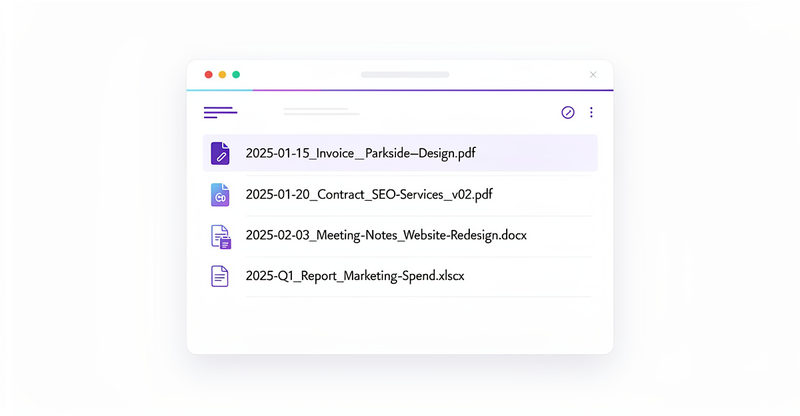
I never had a problem with naming files badly. My problem was not naming them at all. Scans from my phone would land in an Inbox folder as Scan_003.pdf, IMG_4521.jpg, and stay there. Forever. I’d tell myself I’d organize them later, but later never came. Finding that one receipt from three months ago? Good luck.
After finally getting fed up, I developed a file naming convention that actually sticks. These five rules work for me, though your mileage may vary. Take what’s useful, ignore what isn’t. And if you already know you’d never keep this up by hand, software can apply a convention to new files as they arrive — but the convention still has to be yours.
1. Start with the Date (YYYY-MM-DD)
This single change had the biggest impact on my file organization. In any file naming convention, date format is the first decision to make, and ISO format is the right one. When you put the date first, everything sorts chronologically by default.
The format: 2026-01-15 for January 15th, 2026. Year first, then month, then day, always with leading zeros.
What I used to have:
Invoice Jan 15.pdfMeeting notes 2-3.docxQ1 report.xlsx
What I do now:
2026-01-15_Invoice_Parkside-Design.pdf2026-02-03_Meeting-Notes_Website-Redesign.docx2026-03-31_Q1-Report_Sales.xlsx
Why does this work? Computers sort text alphabetically, and 2026-01-15 naturally comes before 2026-02-01. Your file browser does the organizing for you.
A note on format: I’ve debated this endlessly with colleagues. Some prefer YYMMDD (like 240115) because it’s shorter. But I find it harder to read at a glance. Is that January 15th or the 24th of some month? If you’re only using it for sorting, the short format works. If you actually want to read the date, the full YYYY-MM-DD is clearer. In a team, just pick one and stick with it.
When to skip the date entirely: If you’re working within a cloud provider that has solid search and sorting by modification date, you might not need dates in filenames at all. Google Drive, Dropbox, and others let you sort by “last modified” or search by date range. The date prefix matters most when you’re browsing folders locally or need chronological order to be visible in the filename itself.
I use dates for:
- Invoices and receipts: finding last month’s expenses takes seconds
- Meeting notes: easy to trace back what was discussed when
- Contracts: immediately see when something was signed
- Quarterly reports: use
2026-Q1instead of a specific date when the document covers a whole quarter
For photos and personal files that I mostly search for? I often skip the date.
2. Mind Special Characters (Spaces Are Usually Fine)
This one comes with a caveat: for most people, spaces are fine. Windows, macOS, Google Drive, OneDrive and SharePoint all handle them, so Q4 Sales Report.xlsx works in Finder, Explorer and the cloud alike, for you and for your team.
The no-spaces rule is a habit from older systems. It still matters in a few places:
- Scripts and command-line tools, where a name with spaces has to be wrapped in quotes.
- Web addresses: if a file’s name becomes part of a URL, a space turns into
%20. - Strict upload portals. Some court and government e-filing portals accept only letters, numbers, hyphens and underscores in file names, with no spaces at all.
If your files end up there, use hyphens or underscores. Otherwise, spaces are a perfectly good separator.
Characters that actually cause trouble:
< > : " / \ | ? *are forbidden on Windows, OneDrive and SharePoint. Google Drive accepts them, but they cause problems as soon as a file syncs to a Windows computer.#and%aren’t supported in some SharePoint and OneDrive setups.- A space or period at the very end of a name confuses Windows.
- Some business tools are stricter still: QuickBooks Online, for example, rejects attachments with special characters in the file name.
Safe separators:
- Spaces, hyphens (
-) or underscores (_). Pick one style and stick with it.
I’ve settled on hyphens for readability within names and underscores between major parts. So 2026-01-15_Invoice_Parkside-Design.pdf breaks down as: date, type, client.
The practical version: Consistency matters more than which separator you pick. If your files feed into scripts, a website or a strict upload portal, skip spaces. Everywhere else, use what reads best for you and your team. This is one naming convention rule where context matters more than theory.
3. Version Numbers Beat “final” Every Time
We’ve all seen this folder:
Proposal.docxProposal_final.docxProposal_final_v2.docxProposal_final_FINAL.docxProposal_use_this_one.docx
The problem with “final” is that it’s never actually final. There’s always one more round of feedback. A good file naming convention solves this with version numbers from the start.
I use simple version numbers: v01, v02, v03. Two digits matter. Otherwise v10 sorts between v1 and v2 instead of after v9.
For documents that go through review cycles, I add status labels:
DRAFT: still working on itREVIEW: sent for feedbackAPPROVED: signed off, don’t touch
A typical progression:
2026-03-15_Proposal_Greenfield-Inc_v01_DRAFT.docx2026-03-18_Proposal_Greenfield-Inc_v02_REVIEW.docx2026-03-20_Proposal_Greenfield-Inc_v03_APPROVED.docx
When a project wraps up, I move old versions into an Archive subfolder. The main directory stays clean.
Still living with final_FINAL_use-this-one.docx? Filently names every document consistently from the start. No more version chaos.
Your convention, applied to every incoming document.
4. Keep File Names Descriptive, Not Verbose
There’s a balance here. Too short and the name is useless (doc1.pdf). Too long and it gets cut off in your file browser.
I aim for 30-50 characters before the extension. Enough to know what’s inside, short enough to read at a glance.
My template:
[Date]_[Type-or-Project]_[Details]_[Version].ext
Some examples, including an invoice naming convention that works for freelancers and small teams:
| What it is | How I name it |
|---|---|
| Invoice | 2026-01-15_INV-1042_Riverside-Media.pdf |
| Contract | 2026-02-01_Contract_SEO-Services_v02.pdf |
| Product photo | Product_Running-Shoes_Side-View.jpg |
| Quarterly report | 2026-Q1_Report_Marketing-Spend.xlsx |
| Client meeting | 2026-01-15_Meeting_Rebranding-Kickoff.docx |
The invoice naming convention (YYYY-MM-DD_INV-[number]_[client].pdf) is worth standardizing first. Invoices are the documents you search for most at tax time. If invoices arrive regularly, tools can apply this convention to them for you, reading vendor and date straight from the PDF.
Words I’ve stopped including:
- “the”, “a”, “an”, unnecessary padding
- “document” or “file”, it’s obviously a file
- My own name, I know I made it
The_Final_Project_Document_File_v2.docx becomes Project-Brief_v02.docx.
5. Pick a File Naming Convention and Actually Use It
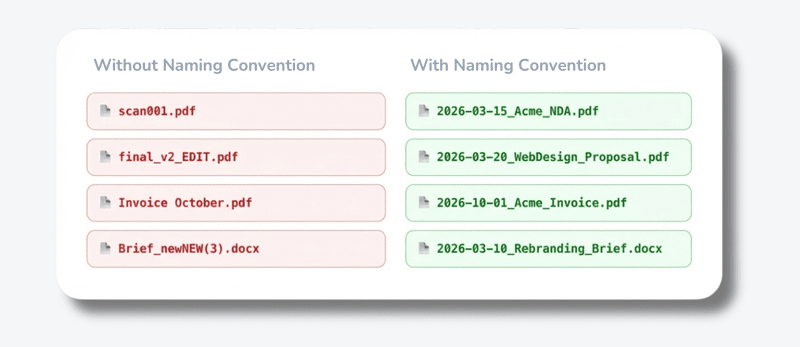
An okay system you follow beats a perfect system you ignore. I’ve seen people spend hours designing elaborate naming schemes, then abandon them after a week because they were too complicated.
Start simple. You can always refine later.
For solo use: Just start applying the rules to new files. You’ll internalize the pattern quickly. Rename old files only when you need to touch them anyway. No need for a massive cleanup project.
For teams: This is where documentation matters. Put the conventions in a shared doc, include examples of good and bad names, and add it to onboarding. Otherwise you’ll end up with five different naming styles across the same project.
Five things to nail down:
- Spaces, hyphens or underscores? (I use hyphens within words and underscores between sections)
- Date at the start or skip it?
- If using dates:
YYYY-MM-DDor something shorter? - How to handle versions?
- Any prefixes for document types? (INV for invoices, etc.)
Whatever you decide, the team needs to agree. Individual preference is fine when you’re solo; consistency matters when you’re not. Five tools apply a convention like this automatically, from free batch renamers to AI that reads the file first. Once the convention is set, automating document filing is the next step to make it run without manual effort.
File Naming Convention Rules: The Short Version
| Rule | Do This | Not This |
|---|---|---|
| Dates | 2026-01-15 | Jan 15, 2026 or 1-15-24 |
| Separators | One style throughout | Project Report_final-v2 (mixed) |
| Versions | v01, v02 | final, final_v2 |
| Length | Q1-Sales-Report.xlsx | The_Quarterly_Sales_Report_For_Q1_2026_Final_Version.xlsx |
| Consistency | Pick one pattern | Mix styles randomly |
A convention earns its keep fastest where a form asks you for the same fields your filename already holds. Submitting medical bills for an insurance claim is the clearest example: date, provider, amount, once per receipt.
When Manual File Naming Gets Old
These conventions work. But I’ll be honest: manually renaming every invoice, receipt, and contract gets old. Especially for scans that pile up faster than I can organize them.
For quick bulk renaming, cleanname.io is useful. It runs in your browser and applies naming patterns to batches of files.
For ongoing automation, Filently does exactly this for Google Drive users. Drop a document in and it gets renamed and organized automatically, following whatever convention you have set up. An invoice becomes 2026-01-15_Invoice_Riverside-Media.pdf without any manual work. First 25 documents are free, no credit card needed.
The goal isn’t to become a file-naming expert. It’s to stop thinking about file naming entirely, so you can focus on work that actually matters.
Your naming convention is set. Now let it run itself. Filently applies your convention to every new document automatically. You never touch a filename again.
Works the same for email, uploads and scans.
Frequently Asked Questions
What is the best naming convention for invoice files?
UseYYYY-MM-DD_INV-[Number]_[ClientName].pdf. Date first ensures files sort chronologically, the INV prefix makes invoice files instantly distinguishable from other documents. Example: 2026-01-15_INV-1042_Acme-Corp.pdf. This format makes searching at tax time effortless and works in any folder structure or cloud storage. If you receive invoices regularly, tools like Filently can apply this convention automatically without manual renaming.What are 3 file naming conventions?
The three most widely used are: (1) date-first with ISO format (YYYY-MM-DD_Name.ext), which ensures files sort chronologically by default; (2) type-prefix convention (INV_, CONTRACT_, RCP_) to group documents by category at a glance; and (3) version numbering (v01, v02 instead of “final”) to track document revisions without confusion. Most practical systems combine all three.What is the best way to name files with dates?
Put the date first in ISO format:YYYY-MM-DD. January 15, 2026 becomes 2026-01-15. This format sorts alphabetically and chronologically at the same time, so your file browser organizes files by date automatically. For documents that cover a whole quarter or month, use 2026-Q1 or 2026-01 instead of a specific day.What are file naming conventions for personal documents?
For personal files, a simple format works well:YYYY-MM-DD_Type_Description.ext. Examples: 2026-01-15_Receipt_IKEA.pdf, 2026-03-20_Insurance_Home-Policy.pdf, 2026-02-01_Tax-Document_2025-Return.pdf. Consistent date-first naming means you can find any document in seconds by searching for the type or rough date, without remembering which folder it lives in.What are contract naming conventions?
The standard format isYYYY-MM-DD_Contract_PartyName_v01.pdf, with a version number for documents that go through revisions. Example: 2026-02-01_Contract_SEO-Services_v02.pdf. For signed contracts, add a status suffix: 2026-02-01_Contract_SEO-Services_v02_SIGNED.pdf. Keep earlier versions in an Archive subfolder once the contract is finalized, so the main folder only shows the current version.